
Anthropology and the Four Fields
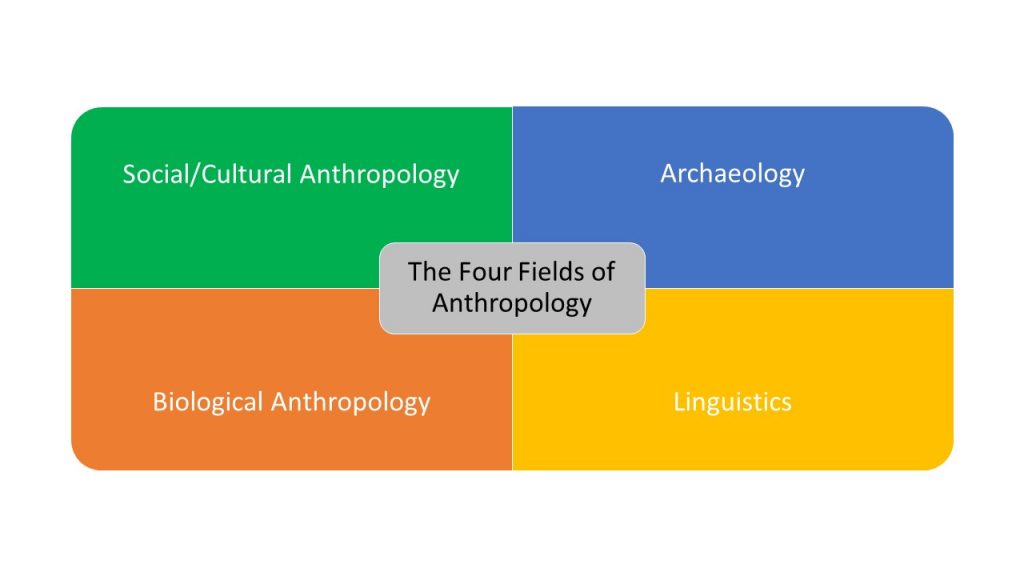
Social anthropology (also called cultural anthropology) is one of the four major fields of Anthropology – an academic field devoted to the study of human beings, past and present.
Some universities teach these four different areas quite closely together, others separate them out more. Researchers can sometimes work in more than one of these fields, but it is typical to specialise.
The AnthNav page is focussed on social anthropology (also known as cultural anthropology) specifically.
What is distinct about Social Anthropology?
Social anthropology focuses on human cultures and societies in the present day. This can cover almost any aspect of human life, from food, to religion, to family, to healthcare, to dance, to money, and much more – analysing norms, values, behaviours, identities, and power structures.
This off-beat but informative 8min video answers the question, “What the F*** is Anthropology?”, locating cultural anthropology within the other anthropological fields, and asking what is unique about it (i.e. what makes up the ‘anthropological lens’).
For a good overview of how social anthropology relates to archaeology, and also distinguishes itself with its own methods, try this conversational 6min video.
Pointing out that social anthropology is less of a topic, and more of a lens, this 10min video by a recent graduate in the UK is a great intro to the discipline.
Where does Social Anthropology fit into Academia?

Social anthropology is generally considered to be a social science.
It also has shared interests with Cultural Studies, Communication Studies, Human Geography, and Gender Studies, among others.
It is a qualitative discipline, meaning it’s not usually focussed on numerical measurements, but on description. However, it is still considered empirical because it is based on observations rather than just ideas.
The type of observations done in social anthropology are naturalistic, meaning they focus on people in real world contexts (rather than lab experiments, for example). Learn about our methods for research here.
 AnthNav